|
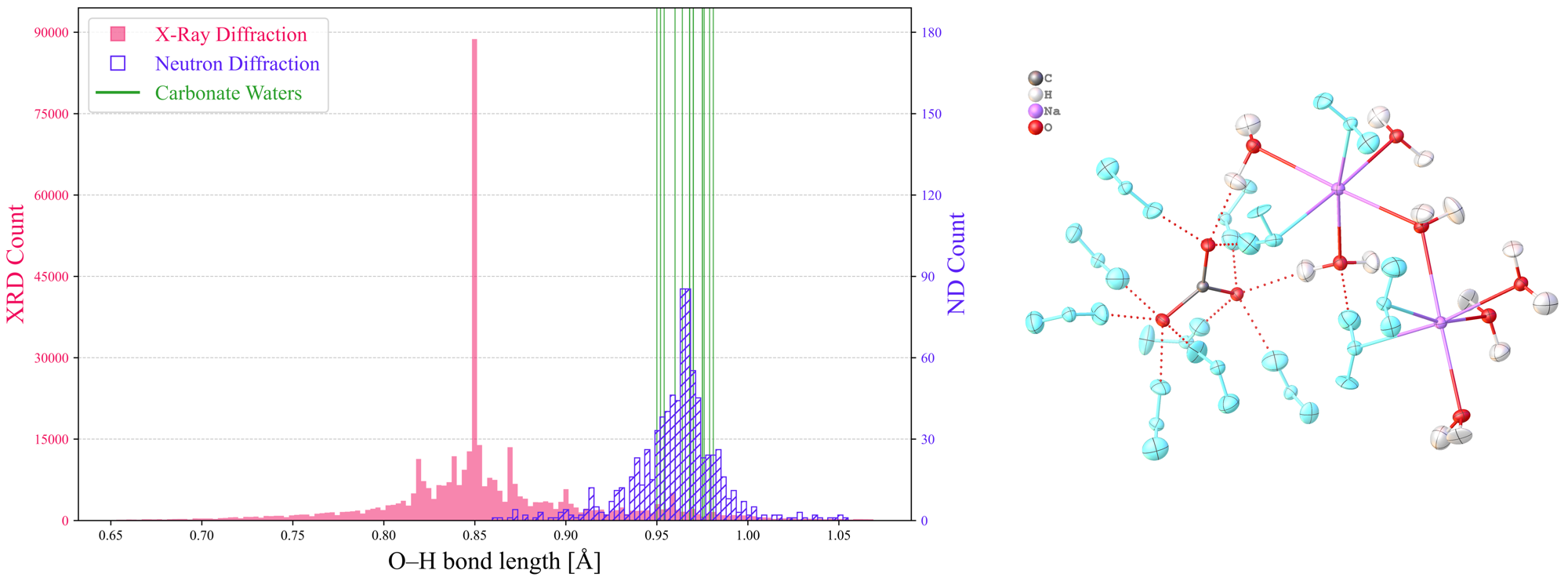
An isolated water molecule has an O-H bond length of 0.958 Å (calculated at CCSD(T)/def2-QZVP). This is not reflected in crystalline hydrates reported in the Cambridge Structural Database determined by X-ray diffraction (XRD). Here, the O-H bonds are all too short (0.859 Å ± 0.056 Å) compared to neutron diffraction (ND, 0.961 Å ± 0.024 Å).
This is the result of the classical refinement method, the Independent Atom Model (IAM), which neglects chemical bonding. Therefore, it artificially shortens bond lengths. These structures are unfit for bonding analyses and necessitate re-refinement using Hirshfeld Atom Refinement (HAR). HAR is a refinement method, which is easily applicable to routine XRD data of sufficient quality. It yields hydrogen positions and anisotropic displacement parameters in agreement with ND results. Its accuracy is exemplified by the XRD measurement of sodium carbonate heptahydrate, whose seven crystallographically independent water molecules fall within bond lengths of neutron diffraction results (highlighted in green).
This research was carried out by Nina M. G. Krapf and Noelle Thür in the group of PD Dr. Simon Grabowsky.
References:
-
M. Woińska, S. Grabowsky, P. M. Dominiak, K. Woźniak, D. Jayatilaka;
"Hydrogen atoms can be located accurately and precisely by x-ray crystallography"
Science Advances, 2016, 2(5), e1600192/1-8;
doi:10.1126/sciadv.1600192.
-
Y. Balmohammadi, L. A. Malaspina, Y. Nakamura, G. Cametti, M. Andrzejewski, M. Siczek, S. Grabowsky;
"Application of a quantum crystallographic protocol to YLID, the world's most common crystal structure"
Nature Scientific Reports, 2025, 15, 15045/1-12;
doi:10.1038/s41598-025-95269-3.
|